Untangling the Word Channel in Amateur Radio
You’ve probably noticed that in amateur radio, the word channel is used in different ways, sometimes in the same conversation. Depending on context, a channel can refer to:
- a name or number a regulator assigns to a frequency
- a range of radio frequency spectrum
- the radio setup needed to communicate with another station
- a memory location in your radio
These different uses of the same word can be a source of confusion when you encounter them. This deep dive explains the meanings you are most likely to encounter, with examples, diagrams, and references if you want to learn more.
A channel is a name or number a regulator assigns to a frequency
For certain radio services, like Marine VHF, Citizens Band (CB), General Mobile Radio Service (GMRS), and Multi-Use Radio Service (MURS), the FCC defines the list of frequencies on which transmissions are allowed, and gives each frequency a channel number or name. These channel identifiers are often the primary method of identifying the station with which you want to communicate.
GMRS is the most straightforward example. The FCC defines 30 channels, each with a single frequency; 22 are used for simplex communication and 8 are reserved for repeater inputs. GMRS channel 20 is always 462.675 MHz. Most GMRS radios don’t show the frequency. You choose a channel number, and can trust that all GMRS radios use the frequency the FCC defined for that channel.
Channels aren’t always referred to by number. The Multi-Use Radio Service (MURS) has 5 channels. Sometimes 154.60 MHz is called MURS 5, but sometimes it’s called Green Dot. Similar to GMRS, any radio that lets you choose the Green Dot channel will communicate with any other radio on which you can select the Green Dot channel.
| Channel | Channel name | Frequency | Maximum bandwidth |
|---|---|---|---|
| 1 | MURS 1 | 151.82 MHz | 11.25 kHz |
| 2 | MURS 2 | 151.88 MHz | 11.25 kHz |
| 3 | MURS 3 | 151.94 MHz | 11.25 kHz |
| 4 | Blue Dot | 154.57 MHz | 20.00 kHz |
| 5 | Green Dot | 154.60 MHz | 20.00 kHz |
The Marine VHF service for ship-to-ship and ship-to-shore communications used alphanumeric channel identifiers for many years. In 2015, the ITU, the FCC, and the United States Coast Guard removed the alphabetic characters from the channel names. Channel 16 means 156.800 MHz. Channel 22A meant 157.100 MHz, but now Channel 1022 means 157.100 MHz. Even though the change is a decade old, plenty of Marine VHF radios still label that frequency as Channel 22A.
Most channels are simplex, but some are duplex. Channel 27 is used for ship-to-shore communications: ships transmit on 157.350 MHz and receive on 161.950 MHz. Shore radios flip the transmit and receive frequencies so they can talk to ships. Two ships can’t talk to each other on channel 27. In Marine VHF, a channel can therefore mean a single frequency or two frequencies. But not for long: duplex channels are scheduled to be phased out by 2030.
The NOAA Weather Radio service broadcasts weather information on seven well-known frequencies between 162.400 MHz and 162.550 MHz. These frequencies are not officially assigned channel designations. However, most consumer equipment that has weather features refers to these frequencies by names WX1-WX7. Because the frequencies aren’t named or numbered by the FCC, different manufacturers end up assigning different channel names to the frequencies. Some radios assign channel numbers based on when the frequencies were added to the NOAA Weather service. In this scheme WX1 is 162.550 MHz because it was the first frequency used by the service. Other brands number the frequencies in ascending frequency order, so WX1 is 162.400 MHz. In practice, this discrepancy doesn’t matter because you just scan through the weather frequencies until you find one on which you can hear the weather broadcast.
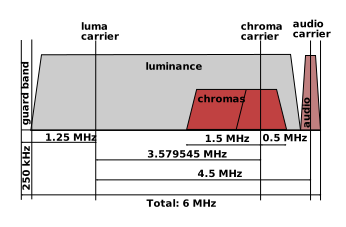
In broadcast television a channel refers to a frequency range. A television broadcast includes many different components: luminance, chromas, audio, closed captions, and more. These components require more than a single frequency to transmit simultaneously. To make it easy for consumers, the FCC defined a set of channel numbers, each of which represents a frequency range. TV channel 5 is always the frequencies between 76 MHz and 82 MHz. A TV receiver set to channel 5 knows which frequencies within that range contain the various components of the broadcast, which it reassembles into the final image and sound that is played for the user.
A channel is a slice of radio frequency spectrum
Channel can refer to an unnamed, unnumbered range or slice of radio frequency spectrum. This slice is used to describe the bandwidth of spectrum a transmitted signal occupies.
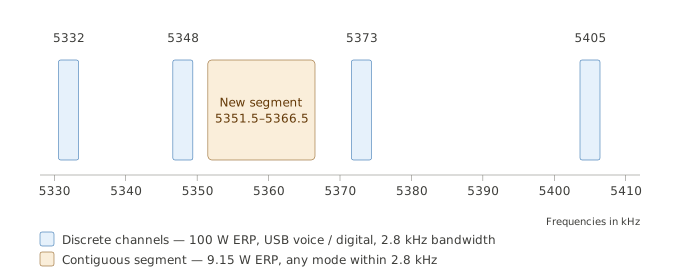
For example, prior to February 2026, the 60 meter amateur band in the United States consisted of five channels. As of February 2026, the FCC modified that band to have four channels and a new non-channelized frequency segment. In the FCC order, they refer to four channels each with a defined frequency and bandwidth. They don’t refer to them by number, i.e. it doesn’t say “channel 1”. In the new segment, it defines the allowed bandwidth, but not a specific frequency, and it doesn’t refer to frequencies in the segment as channels.
On the 60 meter band, a channel refers to 2.8 kHz of bandwidth centered on one of the four defined frequencies (i.e. 5332 kHz), but it doesn’t have a number or name assigned by the FCC.
A channel also refers to the slice of spectrum consumed by a frequency modulation (FM) transmission. Handheld amateur radios (almost) exclusively transmit using FM, not SSB as is common on larger base station radios using lower frequencies. Handhelds support two FM modes, a wide mode and a narrow mode.
FM works by combining the message signal (your voice) with a carrier signal. When you tune your handheld radio to 146.520 MHz, the 2m national simplex calling frequency, that’s the carrier signal frequency. If you are using wide FM mode, when you speak into the microphone, the main FM signal deviates from 146.515 MHz to 146.525 MHz. Sideband energy extends that signal both lower and higher. Carson’s rule gives a formula to estimate the total bandwidth used. In practice it’s approximately 16 kHz. This frequency range, centered on the carrier signal frequency, is called a channel. To avoid interference, wide FM typically uses 20 kHz of frequency spacing on the amateur 2 meter band so transmissions on adjacent frequencies don’t interfere with each other.
Frequency coordination is a voluntary process that amateur radio operators use as part of “good amateur practice” (a term defined by the FCC), to avoid interference on FM repeaters and frequencies. In Utah, where I live, the Utah VHF Society coordinates the repeater and simplex frequencies used on the amateur bands in the state. Utah uses 20 kHz frequency spacing to avoid interference. The band plan says:
2 Meter FM simplex operation (even-numbered 20 kHz channels beginning at 146.420 MHz)
In the context of this band plan, a 20 kHz channel is a slice of radio spectrum centered on a given frequency. The frequencies are selected and spaced so that the approximately 16 kHz bandwidth of the channel doesn’t interfere with transmissions on an adjacent channel (or slice of radio spectrum centered on another frequency).
A channel is the radio setup required to communicate with another station
You might hear someone say, “Let’s move to the 1.25 meter simplex channel”. That means to set your radio to use analog FM at 223.500 MHz. All you need to know is the mode and the frequency. Easy peasy.
Don’t worry, it gets more complicated. Another ham might say, “The net is on the 147.120 channel.” The net is held on a repeater which listens on 147.120 MHz. To communicate with others on the net, you need to know:
- The mode used by the repeater, in this case it’s analog FM
- The frequency on which the repeater transmits signals
- The frequency on which the repeater receives signals
- Any CTCSS or DCS tone which must be included in your transmission in order for the repeater to retransmit it
- The bandwidth of the FM transmission (12.5 kHz or 25 kHz)
- The transmit power which the radio should use
If you want to communicate with another station using a DMR repeater, there are even more settings:
- The mode to use, in this case DMR
- The frequency on which the repeater transmits signals
- The frequency on which the repeater receives signals
- The color code
- The time slot
- The talkgroup to transmit to when you key up
- The bandwidth of the transmission, for DMR it’s 12.5 kHz
- The transmit power which the radio should use
All of these are called channels, meaning whatever radio setup you need in order to communicate with another station. Channel is mostly only used in this way when speaking about stations and frequencies in the VHF and UHF bands. Channel is not usually used this way when talking about HF. For HF, you need the mode and the frequency, and channels kinda aren’t a thing.
A channel is a memory location
A channel often refers to a memory location on a radio. You take the communication setup described above, and save it in a memory location. Save a channel in a channel, which is terrible language construction and no wonder it is confusing. Every handheld radio numbers these memory locations, and most allow you to also assign an alphanumeric name to the memory location. Memory locations let you quickly recall a communication setup when you want to communicate with that station again.
You might hear a ham say something like “save it in channel 135”, or “switch to channel 82”. The Salt Lake County ARES group uses channel in this way in their Standard Frequency Load. The spreadsheet has channel numbers with associated frequencies, offsets, and tones. The intent is for a ham radio operator to store these frequencies in the given memory locations. Doing so makes it much easier for an operator to switch between stations, and to coordinate moving a group of operators to a different repeater.
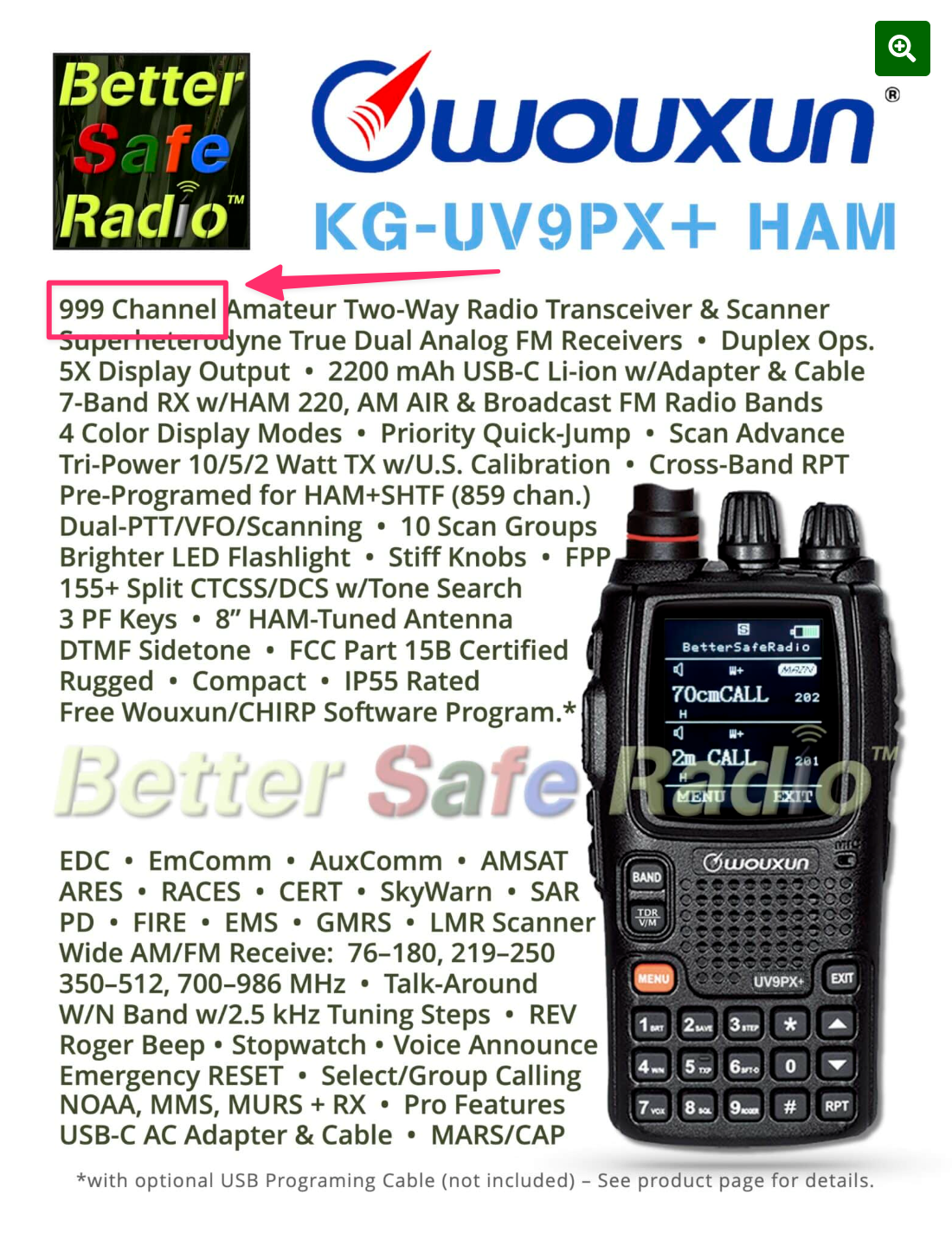
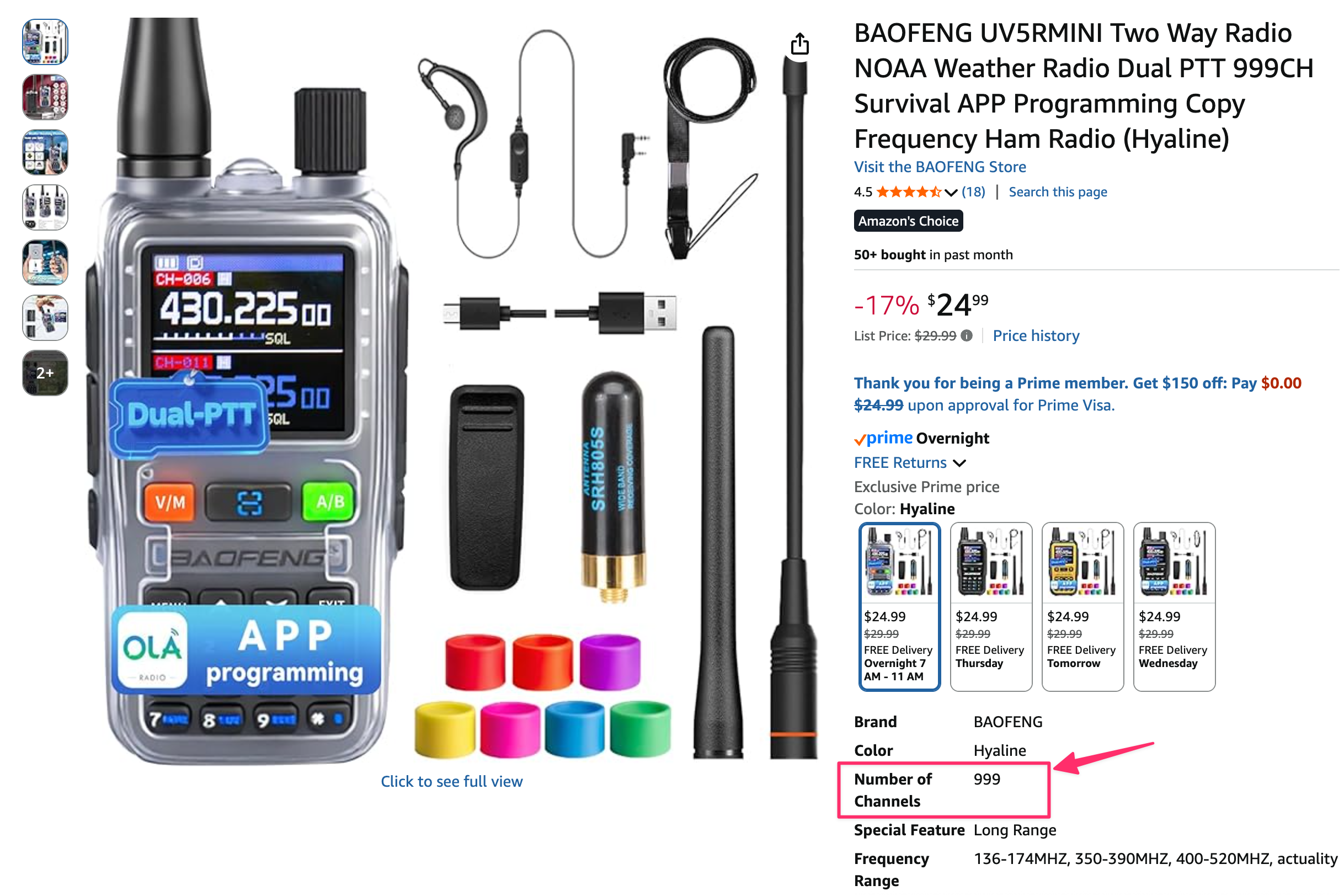
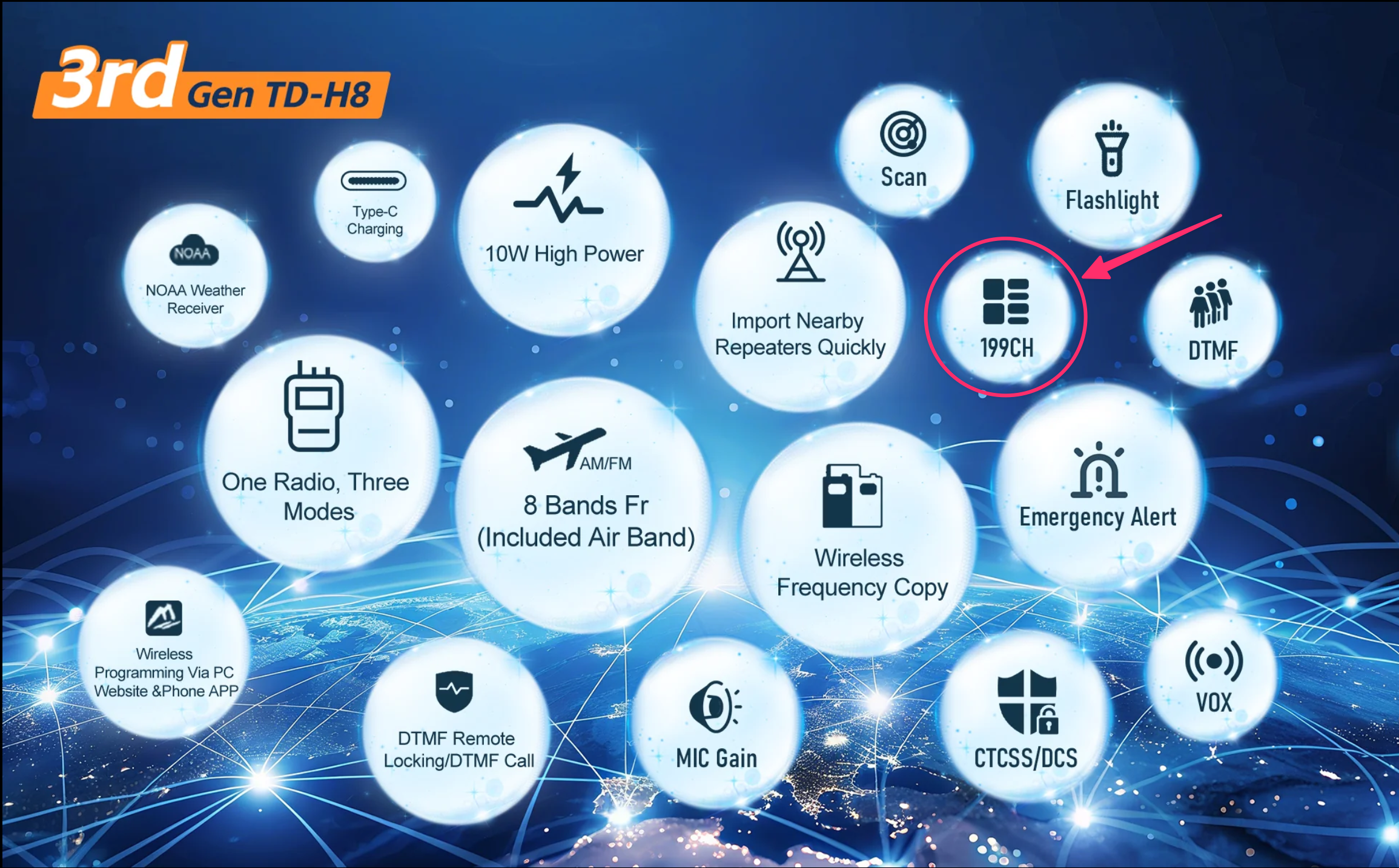
Handheld ham radio marketing materials often tout the number of channels a radio has. In this context, they mean the maximum number of memory locations. Here are some examples:
Other uses of channel
Beyond the four main meanings covered above, you’ll occasionally encounter channel used in a few other ways.
Sometimes you’ll hear hams say “let’s use the 2 meter calling channel”. What they mean is that we should use the frequency in the amateur 2 meter band which has been designated as the national simplex calling frequency: 146.520 MHz. Some radios allow you to program a frequency as the call frequency and then quickly switch to it like you might switch to a memory location.
A priority channel is a feature on many handheld radios where the radio periodically samples one memory location while you’re operating on a different frequency. If a signal appears on the priority channel, the radio jumps to it. In this usage, channel still means a memory location, but the priority qualifier describes a behavior the radio applies to it.
Sometimes FRS and GMRS bubble-pack consumer radios market CTCSS and DCS tone selections as sub-channels. In this market segment, these tone selections are more frequently called privacy codes. I wrote a long article on why these aren’t privacy codes. And they really aren’t channels either, because when you choose a sub-channel, the radio still transmits on the same frequency.
Dual VFO radios usually label the two tuners Band A and Band B. Sometimes it’s Main band and Sub band. But you’ll also see this feature called channel A and channel B. These refer to the two independent tuners the radio can display and (sometimes) monitor at once. Each one can be set to its own frequency or memory location. Here, channel is just the label for the upper or lower display row, which (sometimes) corresponds to two separate receive circuits.
In DMR, a single repeater frequency carries two conversations at the same time using time-division multiple access (TDMA). The two alternating time slots are sometimes referred to as logical channels, so a single DMR frequency is said to carry two channels simultaneously. This is a different sense of channel than the slice of RF spectrum or the memory location or the setup for communicating with another station.
Wrap up
The word channel doesn’t have a single meaning in amateur radio. Depending on the context, it can be a regulator-assigned identifier for a frequency, an unnamed slice of radio spectrum, the full set of settings needed to communicate with another station, or a memory location in your radio. The term picks up still more meanings around the edges, like priority channels, the misleading “sub-channels” of FRS and GMRS, and the A/B labels on dual-VFO handhelds.
This single webpage describing the Radioddity GS-5B uses channel to mean three different things: a memory location, two VFOs and displays, and a radio setup to communicate with another station. No wonder it’s confusing.
Hopefully, you’ll now be able to understand what channel means in all of those contexts.